Global Business, Entrepreneurship,
and Community Development in Silicon Valley (1993–1999)
📍 Extending from Stanford into Silicon Valley Practice

By the spring of 1993, I had fulfilled all requirements for my Ph.D. and postdoctoral work at Stanford, thus formally completing my academic training. I continued living near Stanford, which allowed me to extend several research projects that combined fieldwork with data analysis.
Gradually, however, my focus shifted from campus to industry collaborations, and my partners increasingly came from Silicon Valley’s professional community. Naturally, my personal and professional center of gravity moved to San Jose, the region’s hub. The civic leadership and large-scale network building I had experienced during my Stanford years reinforced my belief that technology and organizations could be designed not only for efficiency, but also for broader societal benefit.
🧰 From SPSS to S / S-PLUS: Upgrading Tools and Processes
Earlier at Peking University in China and during my time in Stanford Sociology, I primarily used SPSS for data storage, analysis, and modeling. While studying in Stanford’s Statistics Department, I adopted S, the sister system to what would later become R, and quickly came to prefer it.
After leaving academia to focus on applied projects, I chose to build with S and collaborated with Insightful in Seattle, which was commercializing it as S-PLUS. During my Silicon Valley years, I continued to develop around S and S-PLUS—work that later fed into what I call the 4E framework for analytic process management, and inadvertently laid some groundwork for subsequent work in the R ecosystem.
🧪 Reflecting on the Limits of Social Science Methods
Frustrated by the limits of prediction and the often surface-level interpretation common in sociology, I joined discussions on the roots of methodological shortcomings— ranging from sampling error, model incompleteness, and estimation bias to researcher intervention.
I wrote reviews of Making It Count as well as works on reflexivity.
At the time, we could clearly identify problems but had no workable solutions, and my perspective diverged from many social scientists I knew. As a result, I shifted more of my energy toward practical applications.
🌏 China Connections and the Origin of CATE DEVELOPMENT

In the years after leaving Stanford, beginning in 1993, I often considered returning to China. Many of my Silicon Valley projects therefore involved partnerships with Chinese institutions. In 1993–1994, I discussed returning to work at Peking University’s Sociology Department with my former advisor, Professor Yuan Fang, and others. An overseas foundation at Peking University had just begun operations and frequently collaborated with me in Silicon Valley.
Meanwhile, I worked to resolve passport and visa issues that would allow me to return to China. Even during my APARC health-systems project, I hosted several delegations from China’s State Science and Technology Commission, co-planning multiple U.S.–China research and training programs.
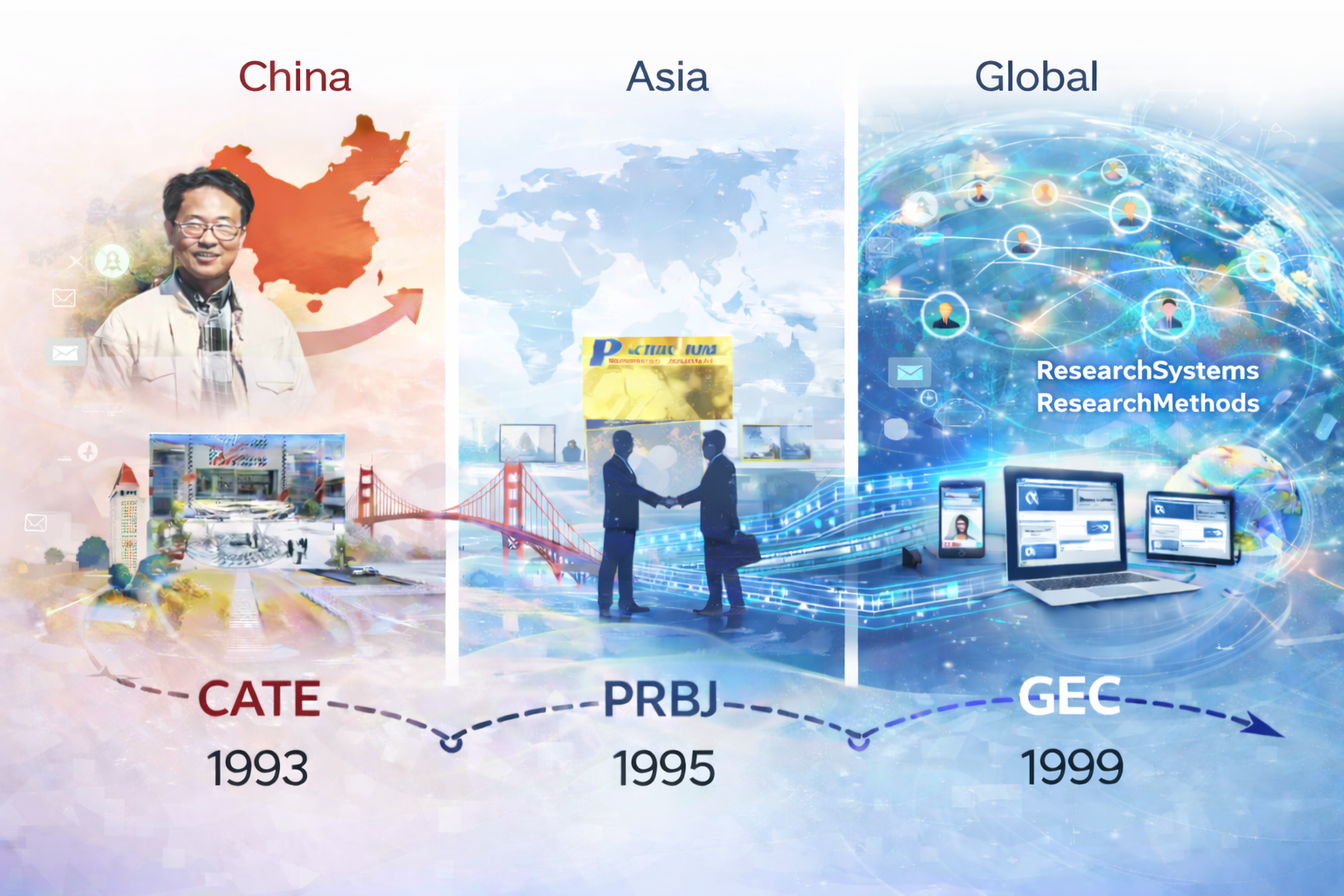
From this effort emerged CATE DEVELOPMENT—a name coined to reflect China–American–Technology–Enterprise collaboration toward shared development, as well as CATE (Community, Association, Technology, Enterprise), a framework emphasizing the use of technology to strengthen enterprises, associations, and communities. I also met with leaders from China’s State Council Leading Group Office of Poverty Alleviation, aligning with my long-standing focus on technology-driven development and poverty reduction through innovation.
🤝 A Wide Range of Projects: From Cross-Border Business to Innovation and Knowledge


Because I worked closely with friends and partners in China, many projects began simply as efforts to help—which made my scope broad at first, spanning multiple domains. That breadth, however, gave me a systems-level view of different communities and their full ecosystems.
The main trajectory of my work first centered on cross-border business, then shifted toward technology innovation and entrepreneurship, and gradually toward research and knowledge-creation management. Many initiatives still leveraged Stanford resources— conferences, training, and entrepreneurship programs.
I initially entered the commercial side as a consultant to a Japanese venture group at NEA and, in 1994, founded CATE DEVELOPMENT, under which I carried out consulting and training, and collaborated with several Chinese enterprises on technology ventures. As business activity expanded, I transitioned from planning a return to China to settling in the U.S. and building global engagements.
📰 PACIFIC RIM BUSINESS REVIEW and Influential Conferences

To support this transition and unify resources across CATE and other Silicon Valley partners, in 1996 we launched the magazine PACIFIC RIM BUSINESS REVIEW. Through the magazine, we expanded into Pan-Asian collaborations and organized several influential events:
- A Stanford Asian Entrepreneurship Conference on campus, with pioneering speakers such as David Lam, serving Asian American professionals.
-
 A San Francisco International Trade Expo featuring Philippine President Fidel V.
Ramos as keynote speaker.
A San Francisco International Trade Expo featuring Philippine President Fidel V.
Ramos as keynote speaker.
- The 1997 Silicon Valley Asian Network Tech Entrepreneurship Conference, with prominent Asian tech founders, including those behind Yahoo and Sina.
- Support for the U.S. Table Tennis Association to host a 25th-anniversary event marking a milestone in U.S.–China relations.
With the above, I increasingly viewed technology as a practical tool for empowering communities through education, networking, information sharing, economic development, and better decision making.
🏛️ Building Community and City Partnerships: From San Jose to Okayama

These conferences broadened my network across Asia and the U.S., and led to service in local organizations, including a board role at the Silicon Valley Asian American Business Association. I became closely acquainted with the City of San Jose and the City of Mountain View, serving as a San Jose development adviser and Sister Cities Committee board member.

Introduced by San Jose, I visited its sister city Okayama, Japan, in 1999, meeting the mayor and business leaders, including the founder of Benesse Holdings. We explored knowledge management systems and briefly collaborated—work that later extended to Hong Kong and Singapore.
🚀 Startup Incubation Ecosystem Approach and the Concept of 4CAPITAL
During these years, I also explored faith communities—attending Catholic and Christian gatherings—and met Taoist and qigong practitioners to reflect on life and purpose.

Professionally, I was invited to join the board of TEN (The Enterprise Network) in San Jose—NASA-funded and known for incubating eBay. I actively engaged with several startups in knowledge management and training systems. The dot-com bubble undercut commercial outcomes, but the experience was formative.
Working closely with TEN’s president, Mr. Musgrave, we articulated a startup incubation support environment and process: ensuring environmental completeness and process optimization as keys to success.
We emphasized building a robust innovation ecosystem and treating four inputs as equally essential: financial capital, intellectual property, social networks, and spiritual support. This early exploration of the 4CAPITAL concept—combined with our experience shaping communities through conferences, magazines, and associations— anchored a holistic approach and prepared the way for my later work with StartX at Stanford. These experiences strengthened my conviction that successful innovation depends not only on technology and investment, but also on social networks, shared purpose, and community support.
🎓 Training, Knowledge Management, and International Collaboration
I studied specialized training methodologies and, through incubation-linked programs, collaborated with UCSC, California State University (San Jose & SLO), and other experts to run programs in organizational management, knowledge management, and data analysis.
I also hosted and trained several Chinese IT companies, including notable individuals such as Zhang Xiaolong, later known as the creator of WeChat.
This period deepened my understanding of international business and entrepreneurship, sharpened my sense of capital operations and organizational growth, and clarified how technological innovation can be harnessed for positive societal impact. These efforts also highlighted the importance of reliable information, measurable outcomes, and organizational learning, gradually drawing my attention toward data, analytics, and evidence-based decision making.
🔄 Refocusing on Data, Analytics, and Human Values
By the end of 1999, seeking a clearer focus for a sustainable long-term career, I chose to recenter my work on what I love most: quantitative social data analysis, research methods, and the study of religious civilizations.
I shifted my efforts to process-management innovation, integrating SPSS/S+ with knowledge-management systems as tools. To make a fresh start in a new professional environment, I left Silicon Valley for Los Angeles and began using the English name Alex Liu.
This marked a tested and deliberate transition: after years of wide-ranging projects—from business ventures and cross-border collaborations to innovation ecosystems—I returned to the core of data and analytics.
At the same time, my interest in religion and human values began to shape how I thought about data science itself. These reflections ultimately led me toward developing human-values-guided data science and AI—a direction that has remained central to my work ever since.
References:
1) PRBJ Special Issue 1997 - Pingpong Diplomacy 25 Years
2) Pingpong Diplomacy 25 Years Event News
