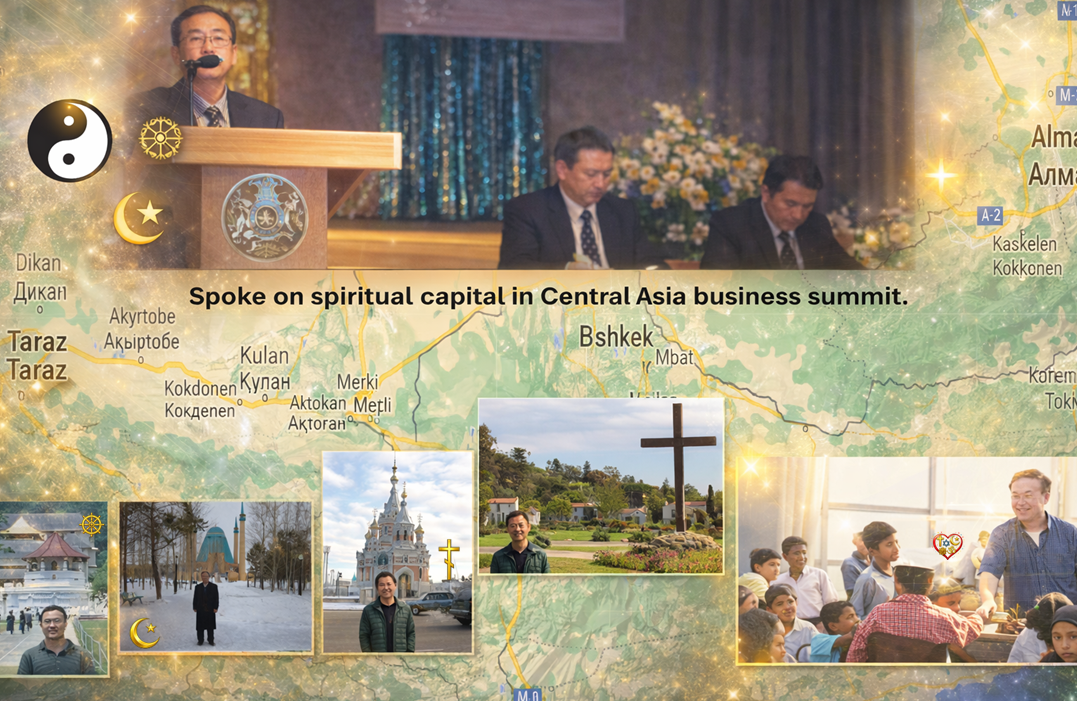
Exploring Faith and Developing Spiritual Capital
in Los Angeles (2000–2009)
📍 Relocating to Los Angeles and Rebalancing Toward Research & Teaching

In 2000, I left Silicon Valley and moved to Los Angeles. In this new environment, I initially continued several Asia-focused engagements in knowledge management and organizational management training, including trips to Hong Kong and Singapore, and I kept serving TEN (The Enterprise Network) in San Jose.
Very quickly, though, I followed my plan to shift the center of gravity toward research and teaching. In the summer of 2001, I presented papers at academic conferences in Sweden and Atlanta; in Sweden I met Muhammad Yunus, later awarded the 2006 Nobel Peace Prize, and his team, initiating some contact and early collaboration.
In the fall of 2001, I taught Sociological Research Methods and SPSS at UC Riverside for one semester, but discontinued due to the commute.
🎓 Building Advanced Methods Teaching in Southern California (RM4Es)

Beginning in the spring of 2002, I served as a part-time faculty member at the University of Southern California (USC), teaching advanced quantitative methods to Ph.D. students in management, political science, and international relations through 2004.
From 2003 onward, I also taught structural equation modeling (SEM) and latent variable methods to Ph.D. students in management and economics at UC Irvine (UCI), a role I continued through 2011. The Rady School at UC San Diego also invited me, but due to distance I served instead as an affiliated advisor to a research center, contributing to several consulting and research projects.
During this period, my 4E approach—Research Method 4Es (RM4Es)—took shape through my courses at USC and UCI, closely linked to work with S/S-PLUS/R and influenced by statistical learning thinking.
🌍 Consulting After 9/11: Data, Development, and Spiritual Capital

Alongside teaching, my consulting grew steadily, often with international scope. I provided evaluation, training, and advisory services in Central Asia, South Asia, and Africa, primarily for UN and USAID projects, all grounded in data for assessment and decision-making.
The 9/11 era shaped these choices, as did the debates I had joined in the 1990s at Stanford around Fukuyama’s “End of History” and Huntington’s “Clash of Civilizations.” I found Huntington’s civilizational analysis more predictive, conceiving “civilization” as rooted in spiritual belief and in the methods used to interpret and forecast social change.
With that lens, I sought assignments across different civilizational contexts, focusing on religion and spiritual capital. Backed by UN and other sponsors, I advocated combining material and intellectual capital with social and spiritual capital in aid programs to maximize impact in poverty reduction.
🇱🇰 Sri Lanka: Impact Assessment, Tech for Peace, and Comparative Faith

In the summer of 2003, I spent a month in Sri Lanka delivering impact assessment training for UN programs to ministerial officials. The country was living under a tenuous February 2002 ceasefire, with bunkers still lining the streets—an environment that underscored our hope that rigorous impact evaluation could redirect large-scale investments toward sustaining peace, representing early efforts in Tech for Good and Tech for Peace.

As a Buddhist-majority country, Sri Lanka also exposed me to new facets of comparative religion. I visited Kandy’s Temple of the Tooth, and, at UN request, met with displaced Muslim communities facing discrimination and conflict.
These experiences deepened my comparative study of religions and catalyzed a systematic exploration of viewing problems through four forms of capital—material, intellectual, social, and spiritual—with spiritual capital as a guiding force.
🇰🇿 Central Asia: Innovation Ecosystems and the GEM Program

From late 2005 to early 2008, I consulted in Kazakhstan, and also in Kyrgyzstan, for USAID and others, helping establish innovation and entrepreneurship centers and adapt Silicon Valley ecosystem practices.
We conducted a national survey on entrepreneurship in Kazakhstan and, in collaboration with London Business School and Babson College, integrated the work into the Global Entrepreneurship Monitor (GEM) program, while training local teams in data analysis.

Both countries are majority Muslim, and conversations with faculty, officials, students, and business leaders expanded my understanding of faith, society, and development. I gave talks on the 4CAPITAL approach and, on a personal note, visited historically significant sites tied to Chinese history and the region of Li Bai’s birthplace—one of my life’s most meaningful cultural journeys.
🇰🇪 Kenya: Evaluating Aid and the Strength of Spiritual Capital

In summer 2007, I spent a month in Kenya evaluating the social impact of U.S. aid and USAID-funded projects. The work reinforced that material and intellectual resources alone were insufficient; social and spiritual capital were often decisive for program success.
Kenya has a sizable Muslim population and was the site of the 1998 bombing of the U.S. Embassy in Nairobi, an event that shaped security and development perspectives in the region. My office during that month was inside the U.S. Embassy, where I heard many stories about Barack Obama’s August 2006 visit as a senator to his father’s homeland.
Later, when he was elected president, I wrote a piece on spiritual capital inspired by his trajectory.
🧪 SEM, Causal Discovery, and Pioneering Measures of Spiritual Capital
 Throughout these years, I pursued teaching, research, and consulting in parallel,
with a scholarly focus on structural equation modeling (SEM) and latent variable
methods. Beginning in 2003, I continued teaching SEM for Ph.D. students at UCI
through 2011, developing a course textbook and a review article on SEM applications
in business research.
Throughout these years, I pursued teaching, research, and consulting in parallel,
with a scholarly focus on structural equation modeling (SEM) and latent variable
methods. Beginning in 2003, I continued teaching SEM for Ph.D. students at UCI
through 2011, developing a course textbook and a review article on SEM applications
in business research.
In summer 2004, I taught a short course in Paris, and in early 2005 I spent nearly six months in New York building, for IBM, an SEM-based causal discovery system and implementing algorithms in SPSS—operationalizing and improving processes inspired by Judea Pearl’s work on causal inference from observational data. This project officially started my work on operational causal analysis, and the future work of operational causal AI.
 This became a strong foundation for subsequent machine learning and AI projects.
At the same time, my applied interests emphasized the link between faith and organizational performance. Because SEM models unobserved latent variables, it was well-suited to studying faith and spiritual capital—work that put me among the early adopters of latent-variable measurement for these constructs. Although I published sparingly, mostly conference papers, this line of work drew frequent mentions and collaboration inquiries.
🔬 Collaborations on Spiritual Capital and the Growth of 4CAPITAL (2008–2009)

Around 2008–2009, I collaborated with a Yale Divinity School project on spiritual capital and with a research center at a university in Ireland. Drawing on lessons from entrepreneurship ecosystems, I articulated and expanded the 4CAPITAL framework —material, intellectual, social, and spiritual—which began to be more widely discussed and cited.
I was invited to advise related master’s and doctoral theses.

These advances were grounded in years of fieldwork and comparative inquiry across Islam, Buddhism, Eastern Orthodoxy, and Christianity. The 4CAPITAL framework became a key foundation for my next-stage work on Chinese traditions of faith and method, and aligned conceptually with my later Ecosystem Approach and Holistic Computation, eventually informing applications in data science and AI guided by human values. By the end of this period, I increasingly viewed data science not merely as a technical discipline, but as a practical framework for generating knowledge, improving decisions, and creating positive social impact.
References:
1) Concept-of-Spiritual-Capital.pdf
